
Why Choose Tonren’s PUR vs EVA Edge Banding Glue for Durable, Global-Grade Furniture Edge Bonding?
In global furniture manufacturing, durability is no longer a competitive advantage—it is a basic requirement. International buyers demand cabinets, wardrobes, office systems, and retail fixtures that withstand humidity, temperature variation, transport stress, and years of daily use. The weakest point in these products is often not the panel or surface finish, but the edge.
Selecting the correct edge banding glue determines whether a product performs reliably across continents or fails under environmental pressure. For manufacturers targeting export-grade performance, the choice between PUR edge banding glue and EVA Edge Banding Glue is a strategic decision that directly impacts brand reputation, warranty costs, and long-term market positioning.
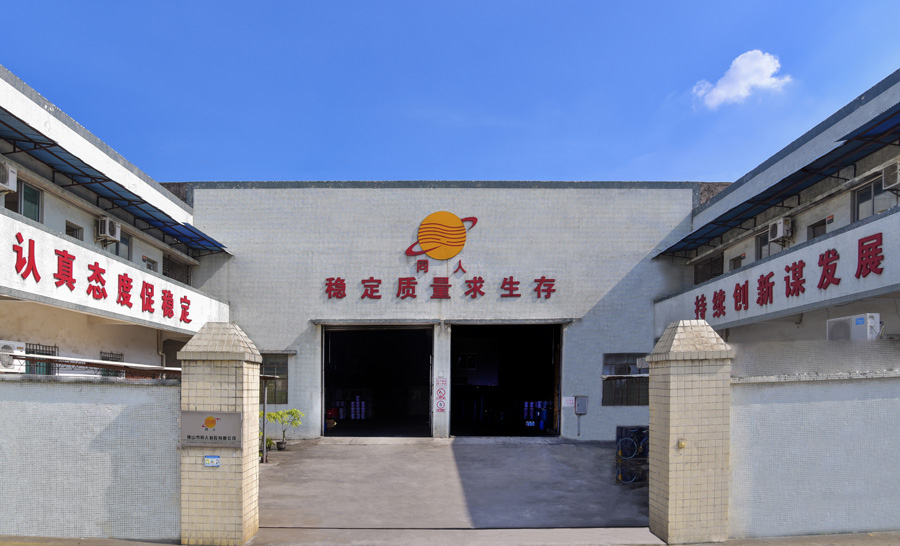
With more than 26 years of adhesive research, production, and global supply experience, Foshan Tonren Adhesive Co., Ltd has developed both advanced PUR systems and high-quality EVA solutions. Since 1999, and backed by ISO9001 certification obtained in 2010, Tonren has provided stable bonding technologies for domestic and international furniture producers.
Understanding the technical differences between PUR edge banding glue and EVA hot melt glue reveals why more high-end manufacturers are transitioning toward reactive systems.
The Fundamental Difference: Thermoplastic vs Reactive Bonding
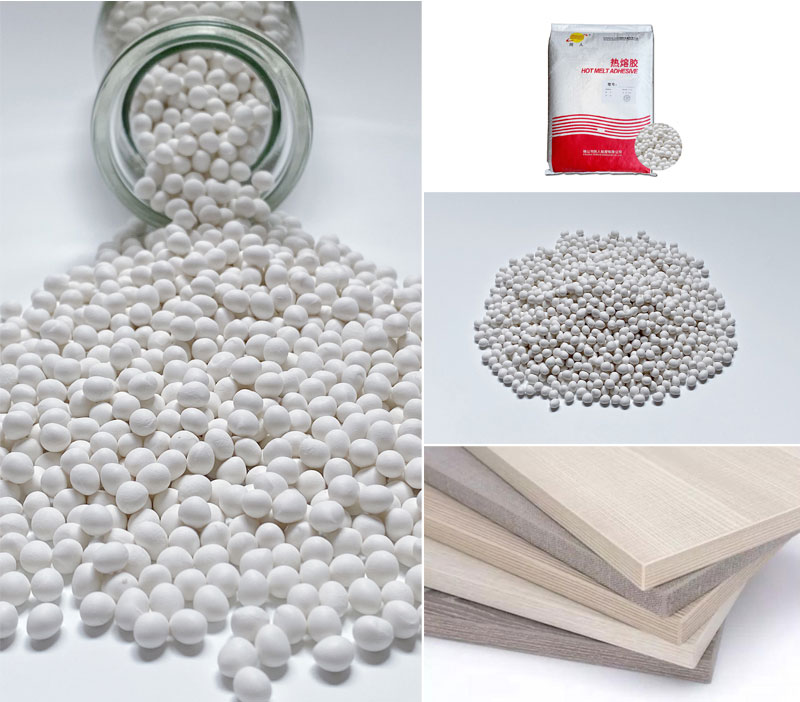
EVA Edge Banding Glue is based on thermoplastic chemistry. It bonds by melting under heat and solidifying upon cooling. This process is efficient and cost-effective, which explains why EVA hot melt glue has been widely adopted for decades.
However, thermoplastic bonding has physical limitations. Under elevated temperature or prolonged humidity, the bond can soften or weaken.
In contrast, PUR edgebander glue uses reactive polyurethane chemistry. After application, it undergoes moisture-triggered cross-linking, forming a thermoset polymer network. This chemical reaction permanently transforms the adhesive structure.
This fundamental distinction between edge banding glue technologies defines long-term durability.
Performance Comparison: PUR vs EVA Systems
| Performance Indicator | EVA hot melt glue | Tonren PUR edge banding glue |
| Bonding Mechanism | Physical solidification | Chemical cross-linking |
| Heat Resistance | 70–90°C | Up to 150°C |
| Moisture Resistance | Moderate | Excellent |
| Aging Stability | Limited | Long-term stable |
| Glue Line Thickness | Standard | Ultra-thin |
| Global Export Suitability | Conditional | Highly Suitable |
The data shows that PUR edgebander glue provides structural advantages for manufacturers targeting humid, tropical, or high-temperature markets.
1️⃣ Moisture Resistance for Global Climates
Furniture exported to Southeast Asia, the Middle East, or coastal regions faces extreme humidity. Under such conditions, EVA Edge Banding Glue may gradually lose bonding strength. Swelling and edge separation can occur when moisture penetrates panel cores.
PUR edge banding glue creates a dense cross-linked network that blocks water infiltration. Unlike EVA hot melt glue, it does not re-soften under environmental stress. This moisture barrier significantly reduces post-installation complaints and extends service life.
For kitchen and bathroom cabinetry, PUR edge banding glue ensures dimensional stability even after repeated exposure to steam and cleaning cycles.
2️⃣ Heat Resistance for Long-Term Structural Integrity
Thermoplastic adhesives soften when exposed to heat. Panels installed near ovens or exposed to direct sunlight may experience bond weakening when using EVA hot melt glue.
PUR edgebander glue maintains structural integrity at higher service temperatures due to its thermoset polymer structure. Even after extended heat exposure, the bond remains stable.
Manufacturers upgrading from EVA Edge Banding Glue to PUR edge banding glue often report measurable improvements in edge retention and reduced rework rates.
3️⃣ Stronger Mechanical Performance Under Stress
Furniture panels naturally expand and contract with environmental changes. The adhesive must absorb stress without cracking or separating.
Traditional edge banding glue offers limited elasticity after cooling. Over time, micro-fractures may develop. PUR edgebander glue combines flexibility with high tensile strength, allowing dynamic movement without bond failure.
Compared with EVA Edge Banding Glue, reactive polyurethane systems deliver stronger long-term shear resistance.
4️⃣ Aesthetic Excellence and Premium Positioning
Modern consumers expect seamless edges, especially in high-gloss or dark finishes. Thick glue lines can reduce perceived quality.
PUR edge banding glue enables ultra-thin application, creating nearly invisible bonding lines. EVA hot melt glue typically produces thicker glue lines due to viscosity and solidification characteristics.
For manufacturers targeting premium retail markets, PUR edge banding glue enhances both durability and visual refinement.
5️⃣ Total Cost Efficiency Over Product Lifecycle
While EVA Edge Banding Glue has lower initial material cost, lifecycle economics tell a different story.
Using PUR edgebander glue can lead to:
Lower failure rates
Reduced warranty claims
Decreased maintenance issues
Enhanced brand reputation
Although EVA hot melt glue remains suitable for standard indoor furniture, high-end and export-oriented manufacturers increasingly evaluate total ownership cost rather than raw adhesive price.
Tonren’s Technical Expertise in Both Systems
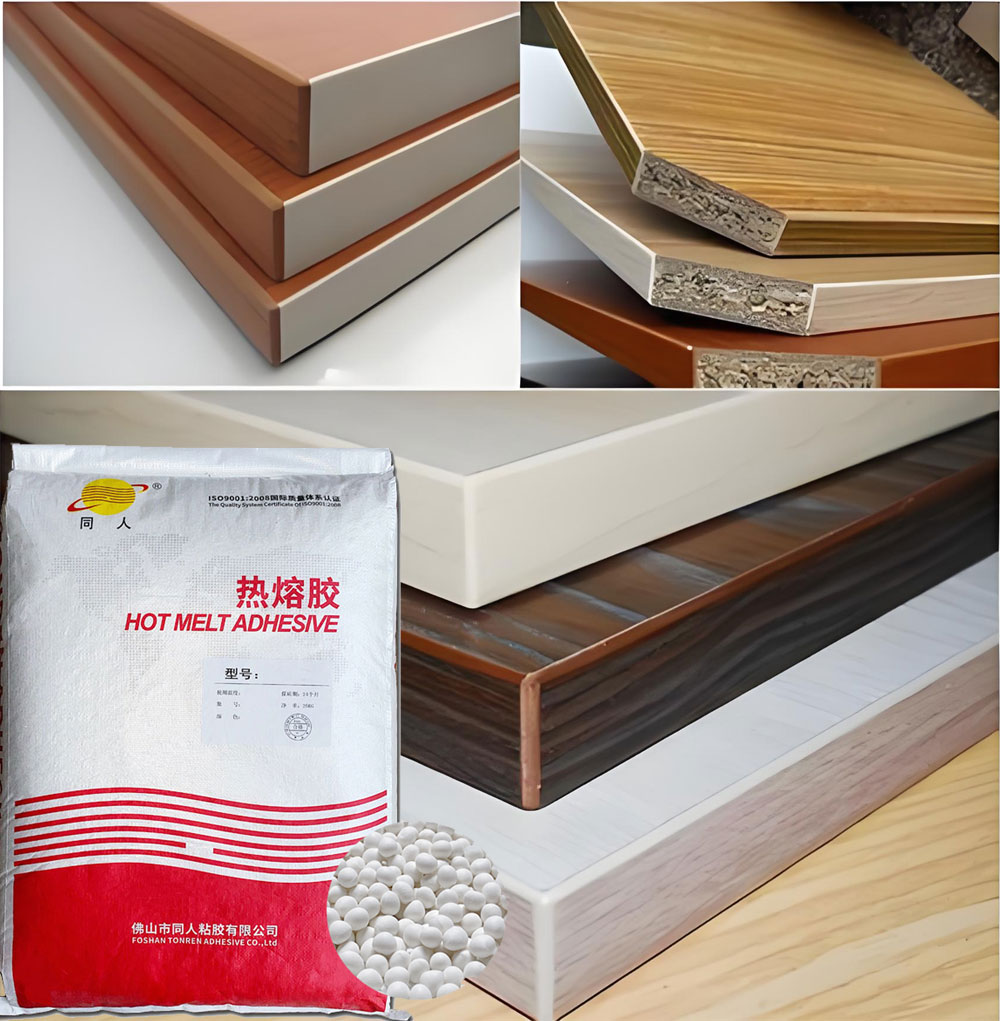
Tonren does not position PUR edge banding glue and EVA Edge Banding Glue as competitors but as solutions for different performance levels.
With 26 years of R&D and manufacturing experience, Tonren ensures:
Stable viscosity control
Optimized open time for automation
Consistent batch-to-batch quality
Compatibility with MDF, particleboard, hardwood, PVC, and ABS
ISO9001-certified production processes guarantee reliability whether customers choose EVA hot melt glue or advanced PUR edgebander glue systems.
This dual-technology capability demonstrates Tonren’s depth of industry expertise rather than reliance on a single formulation.
Frequently Asked Questions (FAQ)
Q1: Is PUR edge banding glue compatible with existing machines?
Most modern edgebanders support PUR edgebander glue with proper melting systems.
Q2: When is EVA Edge Banding Glue still appropriate?
EVA hot melt glue remains suitable for indoor, climate-controlled environments with moderate performance requirements.
Q3: Does PUR edge banding glue require special handling?
Yes. Because it reacts with moisture, sealed storage and proper maintenance are necessary.
Q4: Is the upgrade financially justified?
For export furniture or high-end cabinetry, the improved durability and reduced failure rates typically justify the transition.
Q5: Does Tonren offer technical consultation?
Yes. Tonren provides application guidance, machine parameter optimization, and customized formulation support.
Call to Action
If your goal is to produce furniture that meets global performance standards, evaluating the transition from EVA Edge Banding Glue to PUR edge banding glue is essential. Tonren’s extensive experience in both EVA hot melt glue and PUR edgebander glue ensures that manufacturers receive tailored solutions aligned with production scale and market positioning.
Durability is not achieved by materials alone—it is engineered through chemistry.
Conclusion
The decision between PUR edge banding glue and EVA Edge Banding Glue defines the long-term durability of furniture edges. While EVA hot melt glue remains effective for cost-sensitive applications, global-grade manufacturing increasingly demands the chemical resilience of PUR edgebander glue.
With over 26 years of adhesive expertise, ISO9001-certified systems, and a full portfolio of bonding solutions, Foshan Tonren Adhesive Co., Ltd continues to support manufacturers in producing furniture that performs reliably across climates, markets, and years of use.
Choosing the right edge banding glue is not just a technical choice—it is a strategic investment in durability, reputation, and global competitiveness.