
Why Should High-End Profile Manufacturers Switch To PUR Profile Wrapping Adhesive Instead Of Traditional EVA Hot-Melt Glue?
For high-end furniture and architectural profile manufacturers, the wrapping process can look simple from the outside: apply adhesive, wrap the decorative material around the profile, press it into position, and move to the next piece.
But experienced manufacturers know that the real test begins months or even years later.
A profile may leave the factory with a perfect appearance and still develop edge lifting, adhesive softening, blistering, or delamination after exposure to heat, humidity, cleaning chemicals, or seasonal temperature changes. For export-oriented manufacturers, these failures can quickly become expensive after-sales claims.
This is why more manufacturers are evaluating PUR profile wrapping adhesive as an alternative to conventional EVA hot-melt systems.
The decision, however, should not be based on the assumption that PUR is automatically better for every application. The right question is whether the adhesive technology matches the performance requirements, equipment, substrates, wrapping materials, and target market.
With more than 27 years of adhesive R&D, manufacturing, and international marketing experience, Foshan Tonren Adhesive Co., Ltd provides functional adhesive solutions for furniture, profiles, lamination, edge banding, and other industrial applications. This article explains the practical differences between PUR and EVA for profile wrapping and provides a procurement framework for factories considering an upgrade.
1. The User Problem: Why Is Traditional EVA Hot-Melt Glue Becoming a Limitation?
EVA hot melt remains a widely used adhesive technology in furniture and profile wrapping because it is relatively easy to process, economical, and compatible with many conventional machines.
For standard indoor applications, it can still be a practical solution.
The problem appears when manufacturers move toward high-end furniture, architectural profiles, export products, or demanding environmental conditions.
Common complaints include:
Edge lifting after prolonged heat exposure
Softening of the adhesive layer at elevated temperatures
Bond failure in hot and humid environments
Visible glue lines
Reduced resistance to water and cleaning agents
Delamination after long-term environmental exposure
Different bonding performance between winter and summer production
The fundamental issue is that conventional EVA hot melt relies mainly on thermoplastic adhesion. When temperature rises, the adhesive can soften again.
This does not mean that every EVA adhesive will fail under high temperatures. Product formulation, application amount, substrate, and processing conditions all matter. However, for demanding applications, manufacturers often need a bonding mechanism with greater resistance to environmental stress.
That is where PUR profile wrapping adhesive becomes particularly interesting.
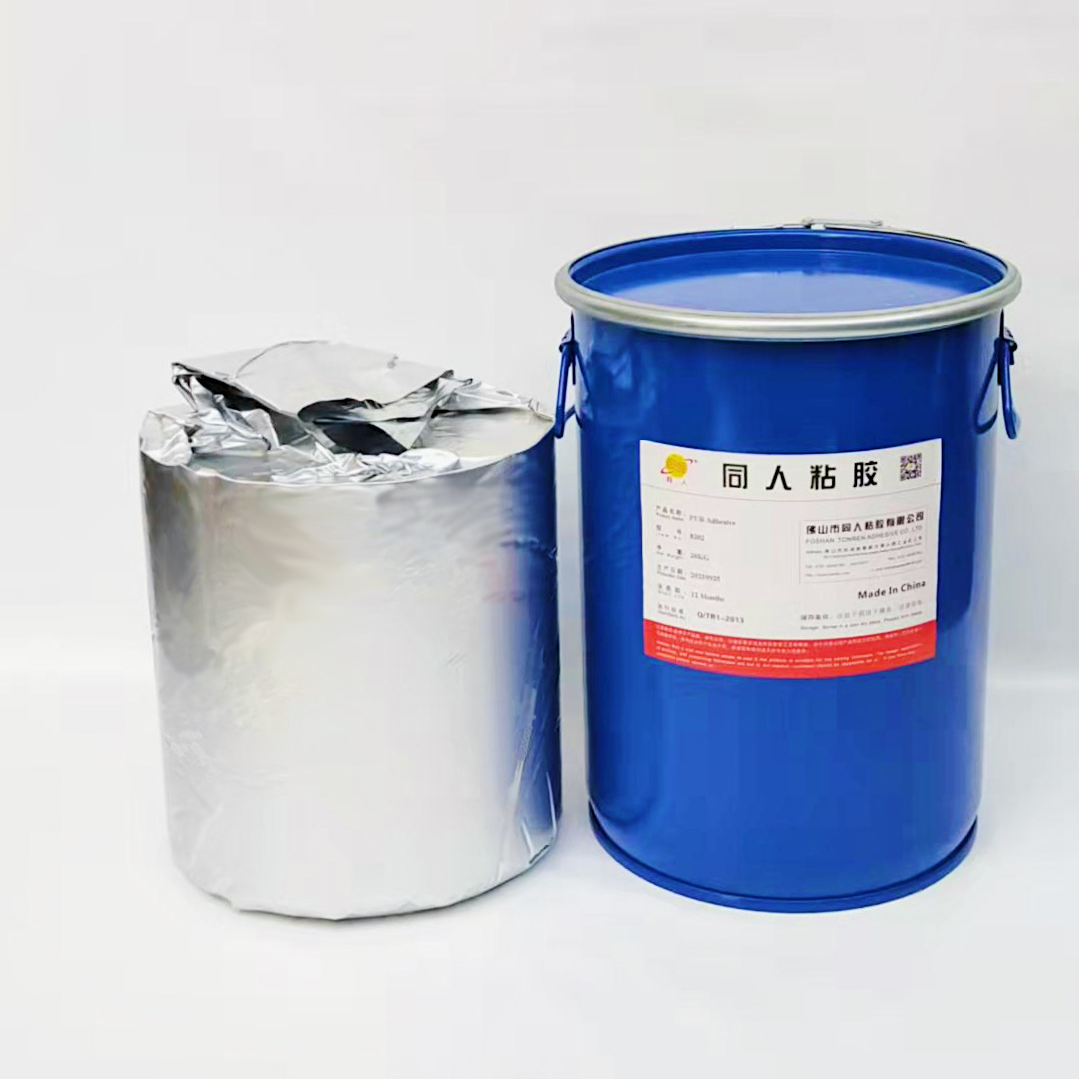
2. PUR vs EVA: What Is the Fundamental Difference?
The most important distinction is not simply “one is stronger.”
It is the way the adhesive behaves after application.
EVA Hot Melt
EVA is a thermoplastic hot-melt adhesive.
It is heated until it reaches a molten state, applied to the substrate, and then solidifies as it cools.
When exposed to sufficiently high temperatures, the adhesive can soften again.
PUR Hot Melt
PUR hot melt is based on reactive polyurethane chemistry.
After application and bonding, the adhesive reacts with moisture in the environment and undergoes further crosslinking.
In simplified terms:
PUR hot melt + moisture → crosslinked polyurethane structure
This reaction changes the adhesive from a primarily thermoplastic system into a more highly crosslinked adhesive layer.
As a result, properly formulated and processed PUR can offer improved resistance to:
Heat
Cold
Moisture
Water
Aging
Solvents and household chemicals
This is the technical reason PUR profile wrapping adhesive is increasingly considered for demanding furniture and architectural profile applications.
3. Performance Comparison: PUR vs EVA for Profile Wrapping
The following table provides a practical comparison for procurement teams.
| Performance factor | EVA hot-melt for profile wrapping | PUR profile wrapping adhesive |
|---|---|---|
| Initial bonding | Good | Very good |
| Heat resistance | Application-dependent | Generally higher after curing |
| Cold resistance | Good to moderate | Generally stronger |
| Moisture resistance | Formulation-dependent | Strong after moisture curing |
| Water resistance | Moderate to good | Generally excellent |
| Aging resistance | Moderate to good | Generally higher |
| Solvent resistance | Limited to moderate | Generally improved |
| Glue-line visibility | Depends on formulation | Can be very low with suitable formulation |
| Long-term crosslinking | No chemical crosslinking | Yes |
| Suitable for demanding export applications | Selected applications | Particularly suitable for demanding applications |
| Equipment requirements | Conventional hot-melt system | Requires PUR-compatible equipment and moisture control |
| Cleaning requirements | Relatively simple | More demanding |
The table should be used as a purchasing guide rather than an absolute laboratory specification. Actual performance depends on the specific adhesive grade, substrate, wrapping material, application conditions, and test standard.
For this reason, professional buyers should always request the supplier's technical data and conduct application trials before mass production.
4. Why PUR Performs Better in High-Temperature Environments
Temperature is one of the most important reasons high-end profile manufacturers consider switching adhesive technologies.
Imagine a dark-colored decorative profile installed near a large window.
The surface can experience substantial temperature increases during direct sunlight exposure. The adhesive layer is repeatedly subjected to thermal expansion and contraction.
With conventional thermoplastic systems, excessive heat can reduce cohesive strength and cause the adhesive to soften.
This creates a potential pathway for:
heat → adhesive softening → stress concentration → edge lifting → delamination
A properly formulated high-temperature resistant profile wrapping glue works differently.
Once PUR has completed its moisture-induced curing reaction, its crosslinked structure provides greater resistance to thermal softening.
This is particularly valuable for:
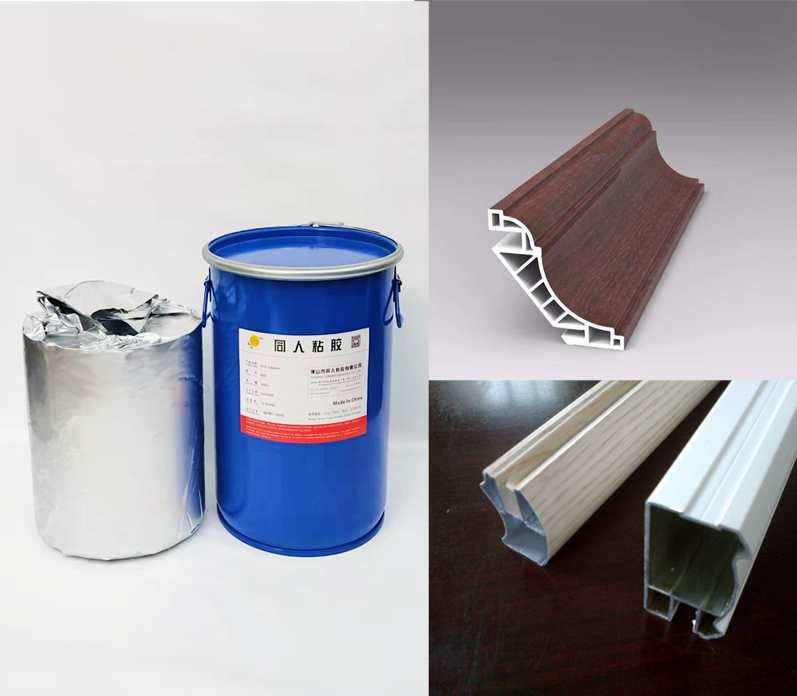
Kitchen cabinet profiles
Door profiles
Window and architectural profiles
WPC skirting
Decorative aluminum profiles
High-end furniture components
For export products, this additional performance margin can be important because the same product may be installed in very different climates.
5. Moisture Resistance: Another Major Advantage
Heat is only half the problem.
Humidity can be even more challenging.
A profile installed in a kitchen, bathroom, coastal residence, or humid tropical market may experience repeated moisture exposure.
If the adhesive layer absorbs water or loses cohesive strength, the wrapping material can gradually separate from the substrate.
PUR's moisture-curing mechanism provides an important advantage.
After curing, the polyurethane network offers stronger resistance to moisture-related degradation than many conventional thermoplastic hot-melt systems.
This makes PUR particularly attractive for products exposed to:
Kitchen humidity
Bathroom environments
Coastal climates
Tropical climates
Seasonal humidity changes
Outdoor or semi-outdoor applications
Again, “water-resistant” should never be interpreted as “indestructible under all conditions.” The complete construction—including substrate, decorative film, primer, profile surface, adhesive and edge design—must be evaluated together.
6. Which Profile Materials Can PUR Be Used With?
One reason high-end manufacturers are interested in PUR is its versatility.
Depending on the adhesive grade and surface preparation, PUR can be used for wrapping a range of substrates and decorative materials.
PVC Film
PVC decorative film is widely used in furniture and interior profiles.
A suitable PUR system can provide strong bonding while maintaining a relatively clean appearance.
Wood Veneer
Wood veneer demands careful adhesive selection because natural wood contains variations in moisture, density, and surface characteristics.
PUR can provide strong adhesion while helping manufacturers achieve durable profile construction.
Decorative Paper
Decorative paper is commonly used for furniture and interior architectural products.
The adhesive must provide sufficient wetting without causing excessive penetration or surface defects.
Aluminum Profiles
Aluminum is a challenging substrate because its surface characteristics differ significantly from wood-based materials.
Proper surface preparation and adhesive selection are essential.
WPC Profiles
WPC skirting and decorative profiles increasingly require durable bonding for residential and commercial applications.
PUR can be evaluated where improved moisture and temperature resistance are required.
7. Application Scenarios for High-End Manufacturers
7.1 Kitchen Cabinets
Kitchen environments combine heat, moisture, cleaning chemicals, and frequent use.
A premium furniture profile lamination adhesive should therefore provide more than initial adhesion.
The finished profile needs to remain stable when exposed to:
Steam
Hot air
Water splashes
Cleaning products
Temperature cycling
PUR is particularly worth considering for high-end cabinet components where long-term appearance matters.
7.2 Door and Window Profiles
Door and window profiles can experience considerable temperature differences between indoor and outdoor environments.
A suitable PUR system can help manufacturers improve resistance to thermal cycling and moisture exposure.
For export-oriented manufacturers, this can be particularly valuable when products are shipped to regions with very different climatic conditions.
7.3 WPC Skirting Boards
WPC skirting is frequently used in modern residential and commercial interiors.
Compared with purely indoor furniture components, skirting may experience greater humidity variation and temperature changes.
A high-temperature resistant profile wrapping glue can therefore provide an additional performance advantage when properly matched with the WPC substrate and decorative film.
7.4 Aluminum Decorative Profiles
Architectural aluminum profiles require careful consideration of surface treatment and adhesion.
PUR can be evaluated for decorative wrapping applications where the manufacturer requires strong long-term adhesion and environmental resistance.
8. PUR Is Not a “Set It and Forget It” Adhesive
There is an important point that buyers sometimes overlook.
PUR offers higher performance potential, but it also demands better process control.
1. Moisture Control
Because PUR reacts with moisture, excessive exposure to atmospheric moisture before application can affect storage stability and processing.
Containers should remain properly sealed.
2. Equipment Compatibility
PUR should be applied using equipment designed for reactive hot-melt adhesive systems.
Ordinary EVA equipment may not be suitable without appropriate modification.
3. Temperature Control
The adhesive must be processed within the supplier's recommended temperature range.
Overheating can degrade adhesive performance.
4. Cleaning
Once PUR begins reacting with moisture, cured residue becomes difficult to remove.
Production lines therefore require appropriate cleaning procedures.
5. Operator Training
Operators need to understand temperature settings, adhesive storage, equipment sealing, application amount, and shutdown procedures.
In other words:
PUR can deliver premium performance, but premium performance requires disciplined processing.
9. Procurement Guide: Should Your Factory Switch to PUR?
Before replacing EVA, procurement managers should ask seven practical questions.
Question 1: What is the final application?
Indoor furniture and demanding architectural applications may require completely different performance levels.
Question 2: What wrapping material are you using?
PVC, ABS, decorative paper, veneer, and other materials require different adhesive compatibility.
Question 3: What is the substrate?
MDF, WPC, aluminum, plywood, and other materials have different surface characteristics.
Question 4: What environmental conditions will the product face?
Consider:
Temperature
Humidity
UV exposure
Water
Cleaning chemicals
Question 5: What is your production speed?
The adhesive must match the machine's application and pressing conditions.
Question 6: Is the existing equipment PUR-compatible?
This should be confirmed before placing a bulk order.
Question 7: Can the supplier provide application support?
A reliable supplier should be able to discuss more than price.
The supplier should understand:
adhesive + substrate + wrapping material + machine + environment + finished-product requirements.
10. Tonren's Factory Solution for Profile Wrapping
For manufacturers considering a technology upgrade, Foshan Tonren Adhesive Co., Ltd brings more than 26 years of experience in adhesive research, production, and international marketing.
Tonren focuses on functional adhesive solutions for applications including:
Edge banding
Profile wrapping
Lamination
Furniture assembly
Solid wood bonding
PUR applications
For profile wrapping applications, Tonren's approach is centered on matching adhesive performance to the customer's actual production conditions.
Rather than recommending PUR simply because it is a premium technology, technical evaluation should consider:
Profile substrate → decorative material → machine → coating method → production speed → environmental requirements → finished-product performance.
This helps manufacturers avoid paying for unnecessary performance while ensuring that demanding export products receive the adhesive technology they actually need.
11. How Tonren PUR Can Support Export-Oriented Furniture Production
Export manufacturers face a particularly difficult challenge.
A profile manufactured in China may eventually be installed in:
Europe
North America
The Middle East
Southeast Asia
Australia
Other international markets
These markets can expose furniture and profiles to very different combinations of heat, humidity, cold, and temperature cycling.
For high-end products, the cost of adhesive failure is much higher than the original adhesive purchase price.
A failed profile can result in:
replacement → reverse logistics → labor → customer complaints → reputation damage → lost repeat orders
This is why manufacturers should consider adhesive as part of product engineering rather than simply a consumable.
A suitable PUR profile wrapping adhesive can help create a stronger performance margin where traditional EVA systems may become less suitable.
12. PUR or EVA? The Practical Decision
There is no reason to declare EVA obsolete.
EVA remains a reasonable choice when:
The application is primarily indoor
Environmental exposure is moderate
Cost is a major consideration
Existing equipment is designed for EVA
Long-term extreme resistance is not required
PUR becomes more compelling when:
High temperature resistance is required
Moisture resistance matters
The product is designed for demanding export markets
Long-term durability is a priority
High-end furniture positioning justifies the upgrade
WPC or architectural profiles require improved environmental resistance
The manufacturer wants to reduce the risk of long-term delamination
The decision should therefore be based on total product requirements, not simply adhesive price.
13. Final Summary: When Does Switching to PUR Make Sense?
The transition from EVA to PUR is not merely an adhesive replacement. It represents a change in the way manufacturers approach profile durability.
EVA hot melt remains useful for many conventional applications. But where manufacturers face demanding temperature cycles, moisture exposure, long service life requirements, or strict export quality expectations, PUR offers a different level of performance potential because of its moisture-induced crosslinking mechanism.
For high-end furniture, cabinet profiles, WPC skirting, aluminum decorative profiles, and demanding architectural products, the additional resistance of PUR can be worth evaluating.
The most important point is to choose the adhesive together with the complete production process.
With more than 26 years of industry experience, Foshan Tonren Adhesive Co., Ltd can support manufacturers in evaluating PUR profile wrapping requirements, including substrate compatibility, wrapping materials, processing conditions, and application requirements.
If your factory is currently using EVA and experiencing edge lifting, softening, or delamination under demanding conditions, now may be the right time to evaluate a PUR solution.
Contact Foshan Tonren Adhesive Co., Ltd with your profile material, wrapping film, machine type, production speed, and target market. A technical assessment and application trial can help determine whether PUR is the right upgrade for your production line.