
Why Do Most PUR Edge Banding Adhesive Suppliers Fail To Meet EU REACH & Low-Temp Production Demands Simultaneously?
A Recent Shipment Reveals What Global Furniture Manufacturers Are Really Looking For
As furniture exports continue expanding into Europe, North America, and other regulated markets, manufacturers are facing a dual challenge:
On one side, they must comply with increasingly strict environmental regulations such as REACH, RoHS, VOC requirements, and product safety documentation.
On the other side, factories are under pressure to maintain stable production efficiency, especially during winter seasons and in low-temperature workshops where conventional PUR adhesives often perform poorly.
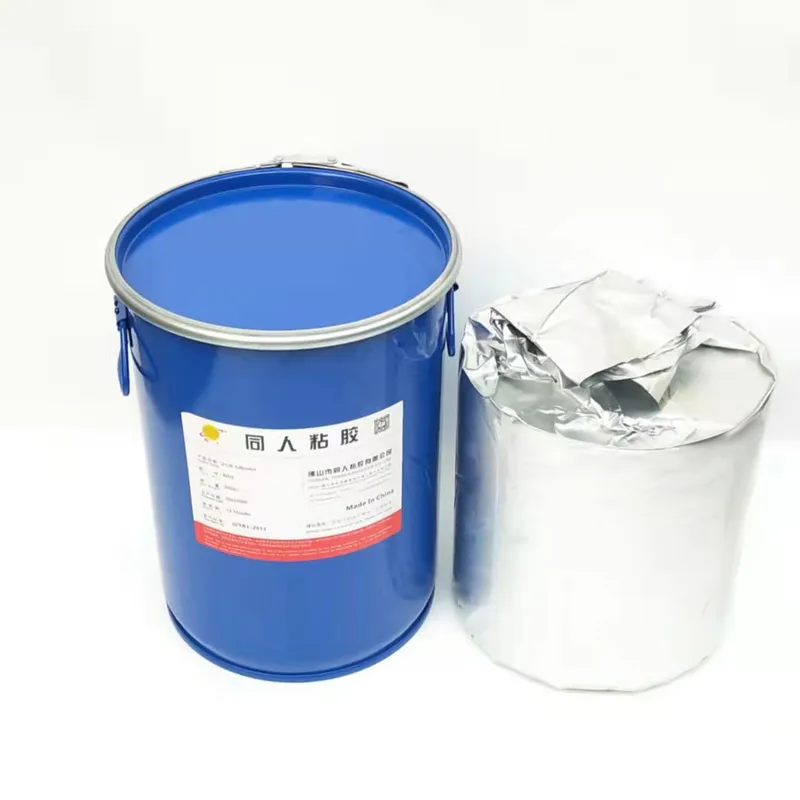
Recently, Foshan Tonren Adhesive Co., Ltd successfully completed another shipment of high-performance PUR edge banding adhesive to an overseas furniture manufacturer that was struggling with both export compliance risks and production inefficiencies.
The customer’s concerns were not unusual:
Existing PUR adhesive lacked complete REACH and RoHS documentation.
Customs clearance risks were increasing.
Low workshop temperatures caused severe stringing.
Excessive adhesive residue led to daily material waste.
Frequent glue pot cleaning reduced production efficiency.
These challenges raise an important question:
Why Do So Many PUR Edge Banding Adhesive Suppliers Fail To Meet Both Compliance Requirements and Production Performance Expectations?
What Is PUR Edge Banding Adhesive?
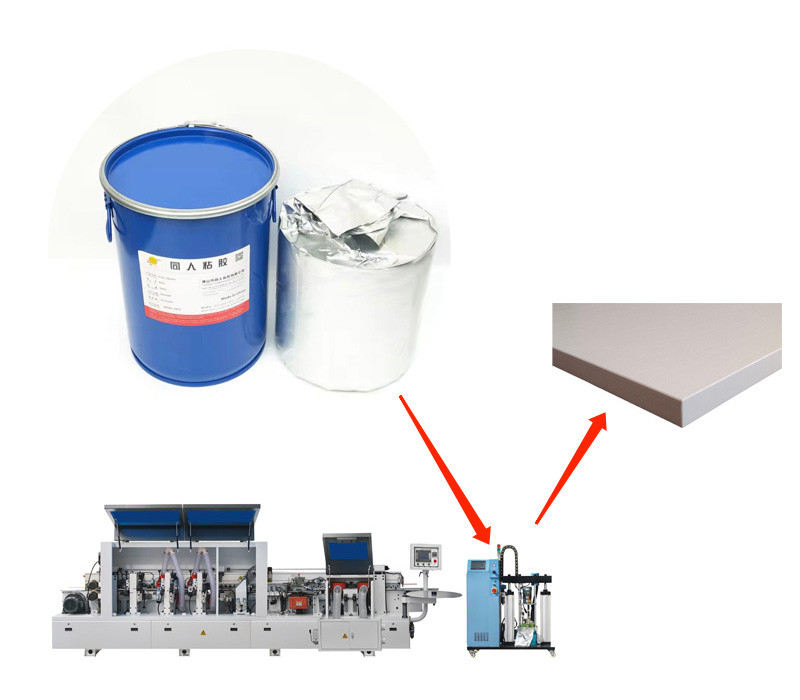
PUR (Polyurethane Reactive) Edge Banding Adhesive is a moisture-curing hot melt adhesive designed for furniture edge banding applications.
Unlike traditional EVA hot melt adhesives that rely solely on physical bonding, PUR adhesives create both:
Physical Bonding
The molten adhesive wets the substrate and edge banding material.
Chemical Cross-Linking
After application, the adhesive reacts with ambient moisture to form a highly durable polymer network.
This dual-bonding mechanism delivers:
Superior bonding strength
Waterproof performance
High-temperature resistance
Low-temperature resistance
Chemical resistance
Long-term durability
Today, PUR edge banding adhesive is widely used in:
Custom furniture
Kitchen cabinets
Bathroom cabinets
Office furniture
Luxury wardrobes
Export furniture
Why Export Manufacturers Face Increasing Compliance Risks
Many furniture manufacturers assume that purchasing PUR adhesive automatically ensures compliance.
Unfortunately, this is not always true.
A significant number of low-cost PUR suppliers cannot provide complete documentation required by international markets.
Common missing documents include:
REACH Compliance Reports
RoHS Reports
MSDS Documentation
VOC Test Reports
SVHC Screening Reports
Without these documents, export shipments may face:
Customs inspections
Clearance delays
Container detention
Product recalls
Customer audits
Supplier disqualification
For manufacturers exporting to Europe, documentation is often just as important as adhesive performance.
Export Risks Are Growing Faster Than Many Suppliers Realize
According to international trade and compliance audits:
| Compliance Issue | Potential Impact |
|---|---|
| Missing REACH Documentation | Customs Delays |
| Incomplete MSDS | Shipment Rejection |
| Excessive VOC Levels | Customer Audit Failure |
| Non-Compliant Raw Materials | Regulatory Penalties |
| Missing RoHS Reports | Market Access Restrictions |
Furniture buyers increasingly require complete traceability and compliance verification before approving suppliers.
In many cases, adhesive documentation becomes part of the supplier qualification process.
The Hidden Problem: Low-Temperature Production Performance
Even when compliance documentation is available, many PUR adhesives encounter serious challenges in cold production environments.
Typical winter workshop temperatures may range from:
5°C–10°C in Northern Europe
8°C–15°C in North China
10°C–18°C in some export manufacturing zones
At these temperatures, ordinary PUR adhesives often demonstrate:
Excessive stringing
Increased viscosity
Poor wetting performance
Slow curing
Higher residue generation
The result is reduced production efficiency and increased operating costs.
Common Production Problems Caused by Low-Quality PUR Adhesives
Problem 1: Severe Adhesive Stringing
Stringing occurs when adhesive filaments remain attached during application.
Consequences include:
Dirty panel surfaces
Reduced product appearance
Increased cleaning workload
Some factories report that winter stringing defects increase by 20%–40% when using unstable PUR formulations.
Problem 2: Slow Moisture Curing
PUR adhesives require moisture reaction to achieve final performance.
Poor formulations may cure slowly under low-temperature conditions.
This can lead to:
Weak early bond strength
Edge lifting risks
Reduced production throughput
Problem 3: Excessive Waste Adhesive
Low-quality PUR systems often leave:
Unusable adhesive residue
Carbonized adhesive deposits
Contaminated glue pots
Factories may discard several kilograms of adhesive weekly simply due to poor thermal stability.
Problem 4: Frequent Equipment Cleaning
Many manufacturers underestimate the hidden cost of glue system maintenance.
Excess residue requires:
More frequent shutdowns
Additional labor
Increased spare parts consumption
Every hour of production downtime directly affects profitability.
What Global Furniture Manufacturers Actually Need
Modern furniture producers need a PUR adhesive capable of balancing:
Regulatory Compliance
AND
Production Efficiency
Unfortunately, many suppliers only excel in one area.
How Foshan Tonren Adhesive Co., Ltd Solves Both Challenges
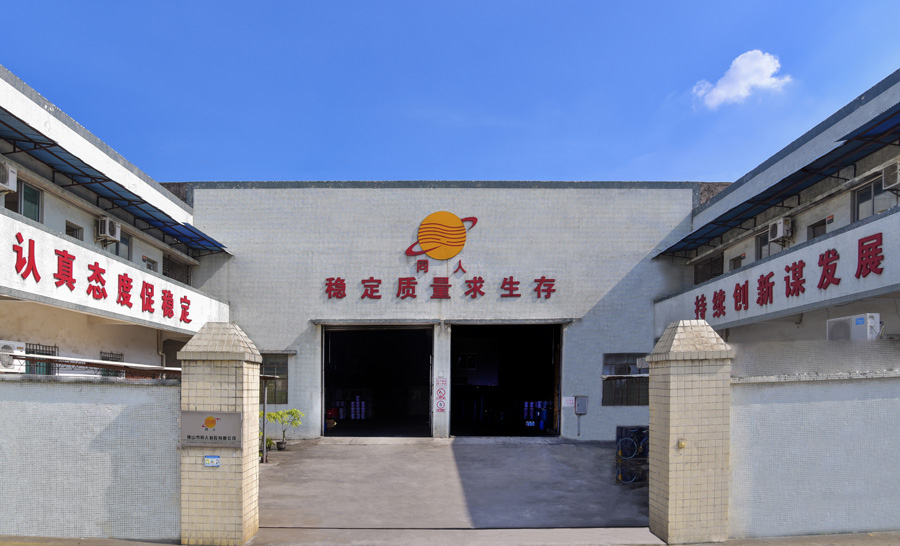
With over 26 years of adhesive manufacturing experience, Foshan Tonren Adhesive Co., Ltd has developed PUR edge banding solutions specifically designed for export-oriented furniture manufacturers.
Our approach focuses on two critical objectives:
Full International Compliance Support
Tonren provides documentation support including:
REACH Compliance
RoHS Compliance
MSDS Documentation
Technical Data Sheets
VOC Information
This helps customers reduce export risks and strengthen customer confidence.
Stable Low-Temperature Processing Performance
Tonren PUR formulations are optimized to provide:
Reduced stringing
Improved flow stability
Faster moisture reaction
Cleaner application
Lower residue generation
This enables furniture manufacturers to maintain stable production even during colder operating conditions.
Application Scenarios
High-End Kitchen Cabinets
Kitchen environments demand:
High humidity resistance
Heat resistance
Long-term durability
PUR technology offers superior performance compared with conventional hot melt systems.
Bathroom Furniture
Bathrooms expose furniture to:
Moisture
Temperature fluctuations
Condensation
Waterproof PUR bonding protects edge integrity over time.
Export Furniture Manufacturing
Export products often experience:
Long-distance transportation
Container temperatures above 60°C
Seasonal climate changes
Stable PUR bonding minimizes post-delivery failures.
Custom Furniture Production
Premium furniture manufacturers increasingly require:
Invisible glue lines
High bonding strength
Long service life
PUR systems have become the preferred solution.
Technical Parameters Buyers Should Evaluate
When selecting PUR edge banding adhesive, consider more than price alone.
| Parameter | Recommended Value |
|---|---|
| Initial Bond Strength | High |
| Heat Resistance | ≥120°C |
| Water Resistance | Excellent |
| Low Temperature Processability | Excellent |
| VOC Performance | Compliant |
| Stringing Control | Low |
| Thermal Stability | High |
| Curing Efficiency | Fast |
| Storage Stability | Reliable |
Data Evidence: Why Better PUR Adhesives Lower Overall Costs
Industry production studies indicate:
| Cost Category | Ordinary PUR | Optimized PUR |
|---|---|---|
| Adhesive Waste | High | Lower |
| Equipment Cleaning Frequency | Frequent | Reduced |
| Production Downtime | Higher | Lower |
| Edge Failure Rate | 2%-5% | Below 1.5% |
| Winter Production Stability | Moderate | Excellent |
| Export Compliance Risk | Variable | Reduced |
Manufacturers upgrading to optimized PUR systems often report:
15%-30% lower adhesive waste
20%-40% fewer cleaning shutdowns
10%-25% improved production efficiency
Reduced after-sales claims
Frequently Asked Purchasing Questions
Is REACH Certification Really Necessary?
If you export furniture or panels into European markets, REACH compliance has become an essential requirement for many buyers and importers.
Why Does PUR String More in Winter?
Lower temperatures increase adhesive viscosity and reduce flowability, causing stringing if formulations are not optimized.
Does Better PUR Always Cost More?
Not necessarily.
A slightly higher adhesive price may significantly reduce:
Waste
Downtime
Cleaning labor
Customer complaints
Total operating costs are often lower.
Can PUR Reduce Furniture After-Sales Claims?
Yes.
Properly formulated PUR adhesives improve resistance to:
Water
Heat
Aging
Delamination
These are among the most common causes of furniture edge banding failures.
Why Choose Foshan Tonren Adhesive Co., Ltd?
For more than 26 years, Foshan Tonren Adhesive Co., Ltd has specialized in developing and manufacturing industrial adhesive solutions for furniture and woodworking industries.
Our product portfolio includes:
PUR Edge Banding Adhesives
EVA Edge Banding Adhesives
Wrapping Adhesives
Lamination Adhesives
Vacuum Membrane Adhesives
Solid Wood Adhesives
Tonren Advantages
✔ ISO9001 Certified Manufacturing
✔ Stable Raw Material Supply
✔ Export Market Experience
✔ Technical Application Support
✔ Customized Formulation Capability
✔ Fast Sample Development
✔ Long-Term Production Stability
✔ Compliance-Oriented Product Development
Your Next Step Toward Safer Exports and More Efficient Production
If your factory is experiencing:
REACH documentation concerns
Customs clearance risks
Winter stringing problems
Excessive adhesive waste
Frequent glue pot cleaning
Rising labor costs
it may be time to upgrade your adhesive system.
The right PUR edge banding adhesive does more than bond edges—it protects product quality, production efficiency, and export competitiveness.
Contact Foshan Tonren Adhesive Co., Ltd today to receive customized PUR adhesive recommendations, technical support, and sample testing services.
Conclusion
The furniture industry is entering a new era where environmental compliance and production efficiency must go hand in hand.
Unfortunately, many PUR adhesive suppliers still fail to meet both requirements simultaneously.
Manufacturers can no longer afford to choose between compliance and performance.
With advanced formulation technology, export-oriented support, and over 26 years of industry expertise, Foshan Tonren Adhesive Co., Ltd helps customers achieve both.
Because the best PUR adhesive is not simply the one that bonds strongest—it is the one that keeps your production running smoothly, your exports moving freely, and your customers coming back year after year.