
Is High-Stability Natural Color Edge Banding Glue a Reliable Choice for Furniture Export Orders With Complex Climate Conditions?
Furniture can pass inspection at the factory and still encounter problems after it reaches the destination market.
A cabinet edge that looks perfectly bonded in the production workshop may begin to lift after several weeks in a humid coastal city. A light-colored wood-grain panel may develop a noticeable yellowish glue line after prolonged exposure to heat and sunlight. In another market, repeated temperature changes between cold warehouses and heated indoor spaces may place additional stress on the edge-bonding interface.
For furniture exporters, these problems are frustrating because the product has already left the factory.
The cost is no longer limited to adhesive or production rework. It can involve replacement parts, customer complaints, distributor claims, additional logistics, and damage to the supplier's reputation.
This is why adhesive selection for export furniture should be based on the actual climate conditions of the destination market, rather than simply the adhesive's purchase price.
For manufacturers and importers handling multi-market furniture orders, natural color edge banding glue for export can be a practical option when visual consistency, temperature resistance, moisture resistance, and material compatibility all matter.
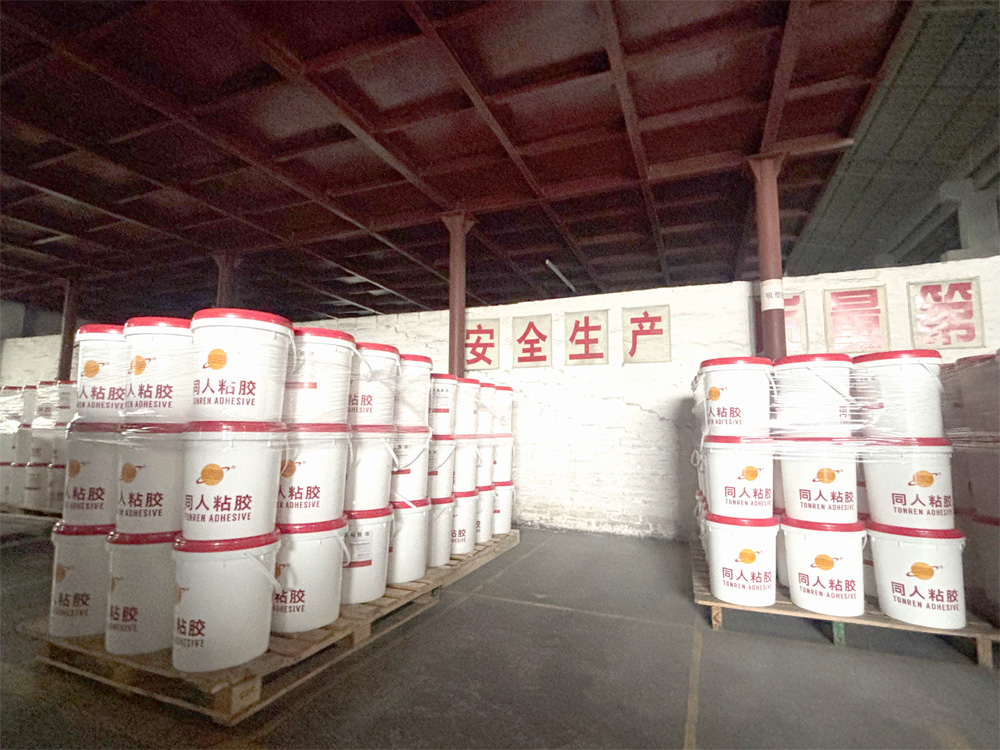
With more than 26 years of adhesive R&D, manufacturing, and international market experience, Foshan Tonren Adhesive Co., Ltd provides functional adhesive solutions for furniture, woodworking, decorative materials, and other industrial applications.
So, can a high-stability natural-color formulation provide reliable edge bonding for furniture exported into complex climate conditions?
The answer depends on how the adhesive is formulated, tested, processed, and matched to the actual furniture application.
1. User Problem: Why Can Export Furniture Develop Edge-Bonding Problems?
Export furniture faces a different operating environment from furniture sold close to the manufacturing plant.
The product may experience several climate transitions:
Factory → Container → Port → Overseas Warehouse → Distributor → End User
During this journey, temperature and humidity can change significantly.
For example, furniture may move from a warm manufacturing environment into a refrigerated or air-conditioned warehouse, then into a hot shipping container, and finally into a humid coastal environment.
These changes can create repeated stress at the edge-bonding interface.
1.1 Temperature Fluctuation Can Stress the Bonding Interface
Different materials expand and contract at different rates.
A typical furniture structure may contain:
MDF / Particleboard + Adhesive + PVC / ABS / Veneer
These materials do not necessarily respond identically to temperature changes.
When the temperature changes repeatedly, the adhesive layer needs to accommodate a certain degree of dimensional movement while maintaining sufficient bonding strength.
If the adhesive softens excessively at higher temperatures or becomes too brittle at lower temperatures, edge lifting or local separation may occur.
This is one reason buyers should evaluate a wide temperature range edge banding glue when furniture is intended for markets with significant seasonal or transportation temperature changes.
2. Humidity: The Often-Overlooked Export Risk
Temperature gets most of the attention, but humidity can be equally important.
Furniture may be exported to:
Tropical regions
Coastal cities
High-humidity markets
Seasonal climates
Dry continental regions
Wood-based panels themselves can respond to moisture changes.
As the substrate absorbs or releases moisture, dimensional movement can occur.
If the adhesive interface cannot maintain adequate bonding performance, the edge may gradually become vulnerable to:
Edge lifting
Local peeling
Glue-line opening
Moisture penetration
Decorative surface separation
Therefore, a professional furniture edge banding adhesive should be assessed under the actual environmental conditions expected during service.
3. Why Can Glue Color Become a Problem After Export?
Bonding failure is not the only issue.
For premium furniture, appearance stability matters just as much.
Light-colored decorative panels can make a yellowish or strongly colored adhesive line particularly noticeable.
This is especially relevant for:
White oak
Natural ash
Beige wood grain
Light walnut
Pale decorative laminates
A glue line that looks acceptable under factory lighting may appear more obvious under bright retail lighting or natural sunlight.
For export furniture, the target is therefore not simply strong adhesion.
The adhesive should ideally provide:
Reliable bonding + stable appearance + compatibility with the selected edge material.
This is where natural color edge banding glue for export can provide an advantage for multi-tone furniture production.
4. Product Selection: What Makes Natural Color Edge Banding Glue Suitable for Export?
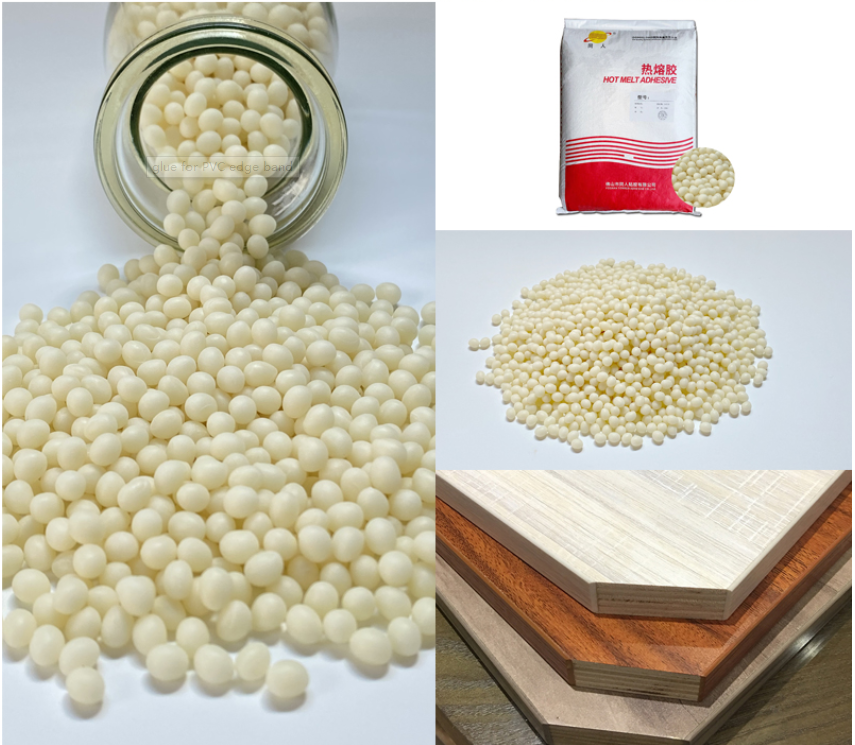
A natural-color formulation is designed to provide a relatively neutral visual appearance, helping reduce the contrast between the adhesive layer and different edge materials.
However, buyers should avoid interpreting “natural color” as “completely invisible.”
The final glue-line appearance depends on multiple factors, including:
Adhesive color
Glue application amount
Edge-band color
Edge-band surface
Panel surface
Machine pressure
Application temperature
Trimming accuracy
Lighting conditions
The purpose of a natural-color formulation is to make the adhesive visually easier to integrate into different furniture designs.
For manufacturers producing many colors and styles for different overseas customers, this can simplify production management.
5. Material Compatibility: PVC, ABS and Wood Veneer
Export furniture rarely uses only one type of edge material.
Depending on the product range, a manufacturer may process:
PVC Edge Banding
PVC remains common in cost-sensitive and high-volume furniture production.
The adhesive needs to provide reliable wetting and bonding under the selected processing conditions.
ABS Edge Banding
ABS edge banding is widely used for furniture requiring a more premium appearance.
The adhesive should be evaluated with the actual ABS formulation and surface condition.
Wood Veneer
Veneer presents different requirements because it is a natural material with variations in surface structure and moisture behavior.
The adhesive selection should therefore account for the veneer type, thickness, surface preparation, and production process.
For this reason, a furniture edge banding adhesive should not be judged solely from a generic technical data sheet.
Actual material compatibility testing is much more meaningful.
6. Technical Parameters Buyers Should Examine
When purchasing natural color edge banding glue for export, overseas buyers should request more than a product price.
A useful technical evaluation can include the following:
| Parameter | Why It Matters for Export Furniture | What Buyers Should Check |
|---|---|---|
| Appearance | Controls glue-line visibility | Natural/neutral color consistency |
| Viscosity | Influences machine application | Compatibility with equipment |
| Application temperature | Determines processing behavior | Recommended operating range |
| Open time | Must match machine speed | Production-line compatibility |
| Initial bonding | Supports immediate handling | Actual production test |
| Final bonding strength | Important for service life | Standardized bonding test |
| Heat resistance | Helps handle hot environments | Elevated-temperature testing |
| Cold resistance | Important during transport | Low-temperature conditioning |
| Moisture resistance | Important in humid markets | Humidity/environmental testing |
| Aging resistance | Supports long-term performance | Accelerated aging evaluation |
| Material compatibility | Prevents substrate-specific failure | PVC/ABS/veneer testing |
| Batch consistency | Important for repeat orders | QC and batch records |
A suitable wide temperature range edge banding glue should be selected based on the complete application rather than one specification in isolation.
7. What Does “Wide Temperature Range” Really Mean?
The phrase “wide temperature range” should be treated carefully.
It does not mean that one adhesive can perform identically under every possible environmental condition.
Instead, it refers to the adhesive's ability to maintain suitable bonding behavior across a broader range of expected operating and service temperatures.
For export furniture, buyers should consider three separate conditions:
Production Temperature
The temperature at which the adhesive is applied.
Transportation Temperature
The temperature the furniture may encounter during storage and shipping.
Service Temperature
The temperature range expected in the customer's home, office, hotel, or commercial environment.
These three ranges can be different.
A professional supplier should evaluate the adhesive against the actual use case rather than provide a vague “high-temperature” claim.
8. Application Scenarios: Where Does This Solution Make Sense?
8.1 Kitchen Cabinets for Overseas Markets
Kitchen furniture may face:
Steam
Warm air
Cleaning chemicals
Temperature fluctuations
Frequent daily use
For export kitchen cabinet orders, adhesive selection should therefore consider both environmental durability and appearance.
8.2 Bathroom and Utility Cabinets
Humidity becomes particularly important in bathrooms and utility spaces.
A suitable furniture edge banding adhesive can contribute to a more reliable edge-bonding system when combined with proper substrate preparation and process control.
8.3 Hotel Furniture
Hotels can expose furniture to repeated cleaning, temperature changes, and intensive daily use.
Large project orders also mean that a small production defect can multiply across thousands of panels.
Stable adhesive performance is therefore important for reducing the risk of repeated edge-related defects.
8.4 Export Wardrobes and Custom Furniture
Custom furniture typically involves multiple decorative finishes.
One project may include several wood-grain colors, making adhesive appearance more important.
A natural-color formulation can help manufacturers maintain a more consistent visual appearance across different product designs.
9. Procurement Decision: What Should Overseas Buyers Ask Their Supplier?
Buying adhesive for export furniture requires more than asking:
“What is your price per kilogram?”
A professional procurement process should include at least seven questions.
1. Can you provide technical documentation?
Request the applicable:
TDS
SDS/MSDS
Product specifications
Recommended processing conditions
Where required by the destination market, ask about relevant compliance documentation.
2. Is the color stable between batches?
This is particularly important for large furniture programs running over several months.
3. Can the adhesive be customized?
Ask whether the manufacturer can adjust the formulation for:
Edge material
Panel substrate
Machine
Production speed
Climate
Appearance requirements
4. Can you provide samples?
Sample testing is one of the most reliable ways to evaluate actual compatibility.
5. Can you support large-volume orders?
Ask about:
Production capacity
Lead time
Batch management
Packaging
Export logistics
6. Can you support different climate markets?
A supplier with application experience should understand that furniture exported to a humid tropical market may have different requirements from furniture shipped to a cold continental market.
7. Can you maintain consistency after the first order?
This is one of the most important questions.
A successful first shipment is not enough.
Furniture manufacturers need the same performance across repeated batches.
10. Factory Solution: How Foshan Tonren Adhesive Co., Ltd Supports Export Furniture Buyers
Foshan Tonren Adhesive Co., Ltd has more than 26 years of experience in adhesive research, development, manufacturing, and sales.
The company focuses on functional adhesive solutions for industries including:
Furniture
Woodworking
Decorative panels
Interior products
Industrial bonding applications
Its product range covers various adhesive applications, including:
Edge banding adhesives
PUR adhesives
Lamination adhesives
3D lamination adhesives
Profile wrapping adhesives
Solid wood adhesives
Other functional adhesive solutions
For export furniture manufacturers, Tonren's approach focuses on the complete production chain:
Material → Adhesive → Equipment → Process → Environment → Finished Product
This is particularly important when dealing with complex climate conditions.
11. Large-Order Customization and Batch Stability
For overseas furniture importers and large manufacturers, product consistency can be just as important as initial performance.
Imagine receiving a shipment where the first production batch has a clean, neutral glue line, but a later batch produces a noticeably different appearance.
The resulting problem can affect an entire furniture series.
Therefore, a reliable natural color edge banding glue for export should be supported by appropriate manufacturing and quality-control procedures.
Tonren can work with customers around factors such as:
Target adhesive characteristics
Application requirements
Packaging format
Production volume
Material compatibility
Technical documentation
Sample approval
Repeat-order requirements
For larger furniture programs, a sample-approved specification can become the reference point for subsequent purchasing and production.
12. Data-Based Quality Control for Export Furniture
The best way to reduce adhesive-related risk is to measure it.
Furniture factories can establish several practical KPIs.
| KPI | Measurement Method | Procurement Value |
|---|---|---|
| Edge defect rate | Defective panels ÷ inspected panels | Measures bonding reliability |
| Glue-line visibility | Visual grading under controlled lighting | Measures appearance |
| Adhesive consumption | kg ÷ edge length | Calculates material efficiency |
| Rework rate | Reworked panels ÷ total production | Measures hidden cost |
| Batch variation | Compare approved vs new batch | Controls consistency |
| Heat resistance | Test after thermal conditioning | Evaluates climate suitability |
| Humidity resistance | Test after humidity exposure | Supports humid-market applications |
| Customer claims | Adhesive-related claims ÷ shipments | Measures field performance |
For example, if a factory produces 20,000 panels per month and adhesive-related rework affects only 1% of production, that still represents:
20,000 × 1% = 200 panels
The direct material loss is only one part of the cost.
Labor, inspection, reprocessing, packaging, delivery delays, and customer service can add considerably more.
This is why selecting a stable adhesive can have a financial impact beyond the adhesive purchase price.
13. How Should Buyers Conduct a Pre-Order Adhesive Trial?
Before approving a large export order, a controlled trial is recommended.
Step 1: Submit Your Actual Materials
Provide representative samples of:
MDF or particleboard
PVC edge banding
ABS edge banding
Veneer
Decorative surface
Step 2: Provide Machine Information
Include:
Edgebander model
Application system
Production speed
Operating temperature
Pressure settings
Step 3: Establish Appearance Criteria
Define what constitutes an acceptable glue line.
For example:
No obvious yellowing
Consistent glue-line appearance
No visible squeeze-out
No edge lifting
Step 4: Conduct Environmental Testing
Depending on the destination market, evaluate the finished assembly under suitable:
Heat exposure
Cold exposure
Humidity exposure
Thermal cycling
Step 5: Confirm the Production Specification
Once the adhesive passes the trial, record the approved product and process conditions for repeat production.
This creates a more reliable purchasing system than changing adhesive products based solely on price.
14. FAQ: Natural Color Edge Banding Glue for Export Furniture
Is natural-color adhesive suitable for all furniture?
Not automatically. Furniture applications differ in substrate, edge material, machine, and environmental conditions. The adhesive should be selected according to the actual application.
Can it prevent edge delamination in humid climates?
A suitable adhesive can contribute to better bonding reliability, but edge performance also depends on substrate moisture, surface preparation, application conditions, and edge material compatibility.
Can it be used with both PVC and ABS?
Many edge-banding formulations can be designed for PVC and ABS applications. Actual compatibility should be verified using the customer's specific materials.
Is a natural-color adhesive completely invisible?
No adhesive should be described as universally invisible. An invisible glue line is a visual target affected by adhesive color, glue amount, edge color, lighting, and machining conditions.
Is a wide-temperature adhesive necessary for every export order?
No. The appropriate temperature-performance range should be determined according to the actual transportation, storage, and service environment.
Can Tonren customize adhesive for large furniture orders?
Foshan Tonren Adhesive Co., Ltd can discuss formulation and production requirements with customers based on materials, equipment, application conditions, volume, and target-market requirements.
15. Conversion Path: From Climate Risk to a Stable Export Solution
If you are an overseas furniture importer, distributor, or manufacturer experiencing edge-bonding problems, the first step is not necessarily to change your entire production process.
Start by identifying the variables.
Send your supplier:
1. Panel substrate
2. Edge-band material
3. Decorative surface
4. Edge thickness
5. Production speed
6. Machine model
7. Current adhesive
8. Destination market
9. Existing defect
10. Required monthly volume
Based on these details, Foshan Tonren Adhesive Co., Ltd can evaluate the application and determine whether a natural-color, temperature-resistant formulation is appropriate.
For international furniture production, the objective is straightforward:
Stable bonding. Stable appearance. Stable supply.
Conclusion: Is High-Stability Natural Color Adhesive a Reliable Choice for Complex-Climate Export Furniture?
Export furniture has to survive more than the production line.
It may experience temperature fluctuations during transportation, humidity changes in warehouses, seasonal climate differences, and years of use by the end customer.
That makes adhesive selection an important part of export quality control.
A properly selected natural color edge banding glue for export can help address two common concerns at the same time:
Bonding reliability and visual consistency.
For manufacturers working with PVC, ABS, veneer, and multiple wood-grain finishes, the right furniture edge banding adhesive should be evaluated for thermal behavior, moisture resistance, material compatibility, processing stability, and batch consistency.
For demanding international markets, a wide temperature range edge banding glue can provide an additional performance margin when the finished furniture is exposed to significant environmental variation.
The most reliable approach is not to select adhesive by price alone.
Instead, evaluate:
Performance → Compatibility → Testing → Batch stability → Total production cost → Export requirements.
With more than 26 years of adhesive manufacturing experience, Foshan Tonren Adhesive Co., Ltd is positioned to support furniture manufacturers, importers, and distributors looking for application-specific adhesive solutions.
Planning a new furniture export project? Send Tonren your panel, edge-band, machine, destination-market, and production requirements to discuss a suitable adhesive solution before placing the bulk order.